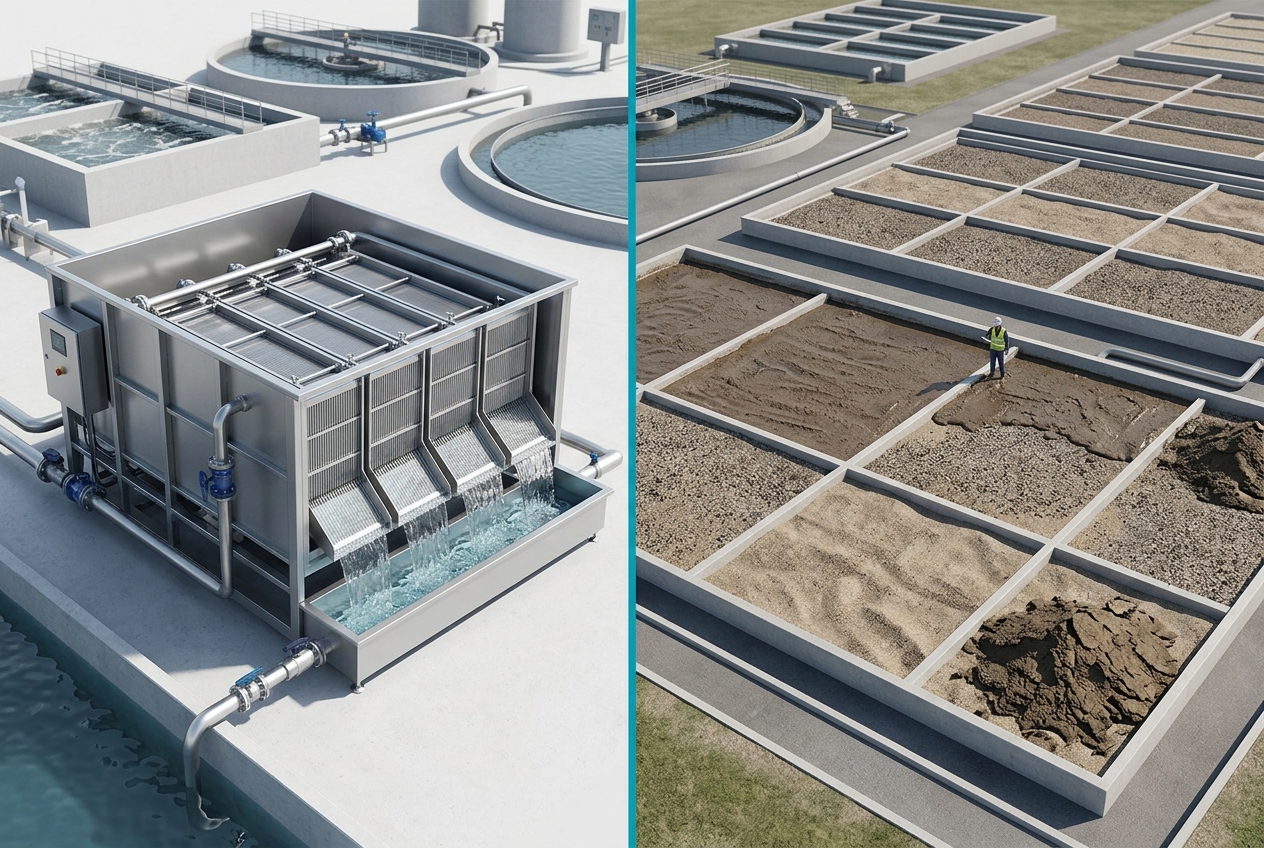
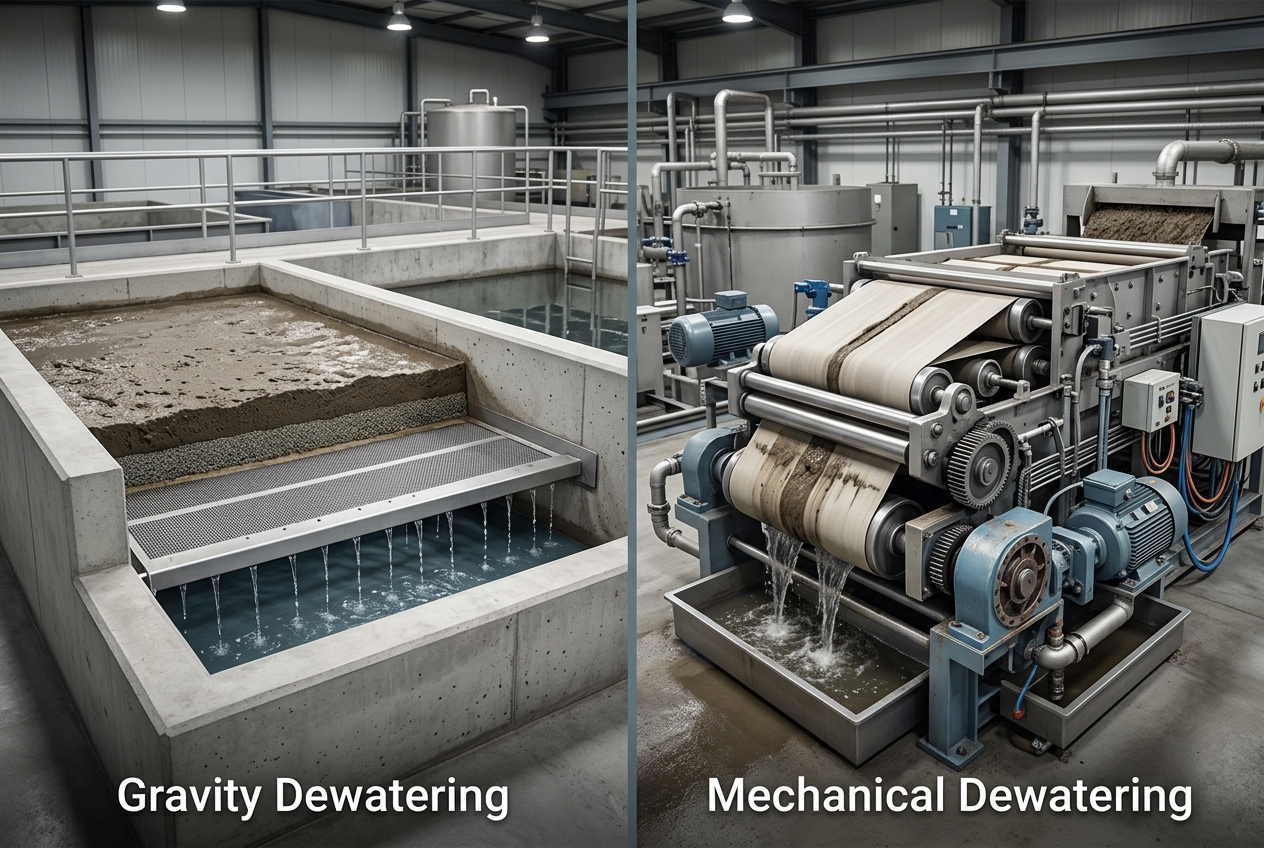
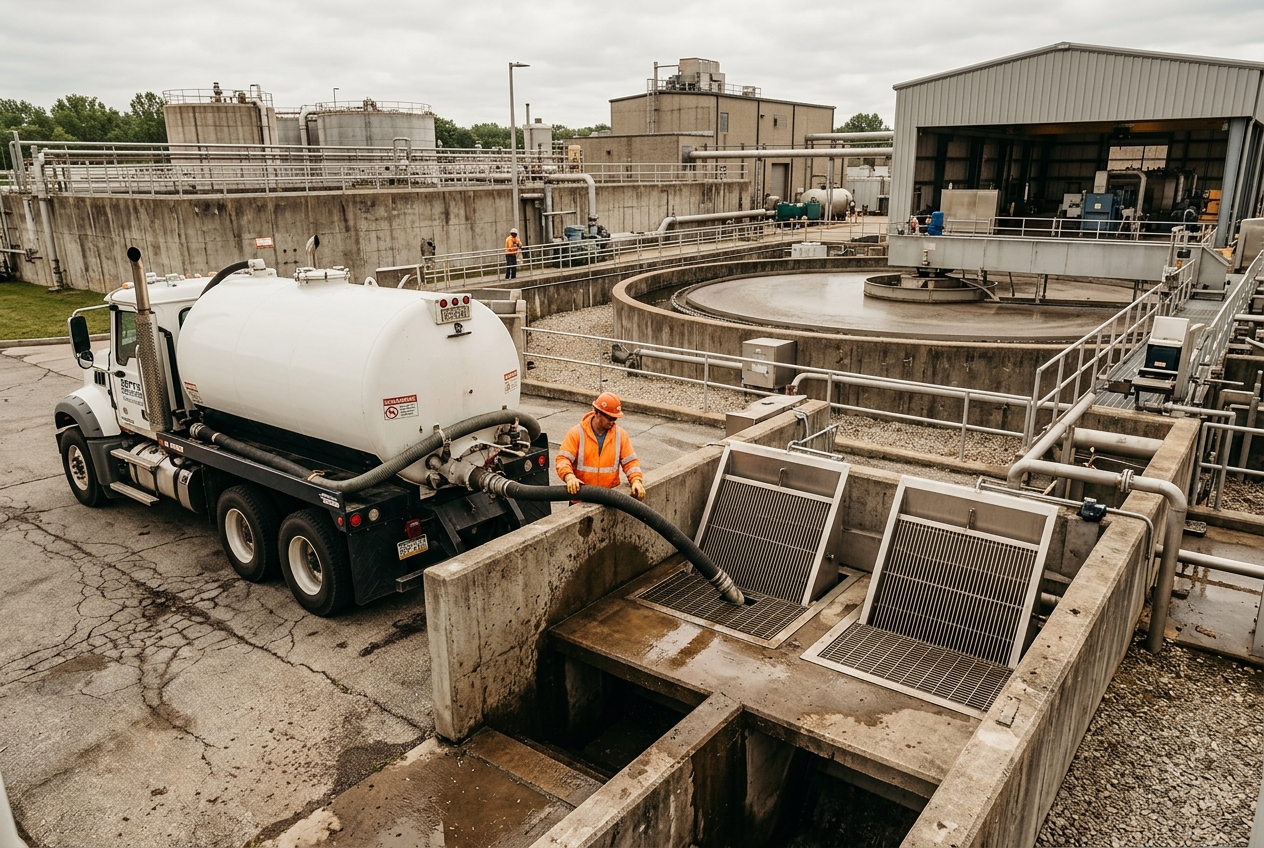
Sizing a sludge dewatering filter bed correctly is one of the most consequential decisions in a wastewater treatment plant’s design. Undersize and you’ll have sludge backing up with nowhere to go. Oversize and you’ve locked capital into idle infrastructure. This guide walks through the calculation process step by step, with a worked example you can adapt to your facility.
Step 1: Determine Daily Sludge Volume
Everything starts with how much liquid sludge your plant generates each day. This figure is a function of influent flow, treatment process, and the chemical additions in your solids handling train.
Key factors affecting sludge volume:
- Plant flow (MGD)
- Primary vs. secondary vs. combined treatment
- Solids content of the feed sludge (typically 1–4% total solids)
- Chemical conditioning additions (alum, lime, polymers)
- Seasonal variation in influent loading
A common rule of thumb for combined primary and secondary sludge: 1,000 to 3,000 gallons per MGD of plant flow, with the lower end for well-thickened sludge and the upper end for dilute or chemically conditioned streams. Always use your actual solids production data where available — rules of thumb are starting points, not substitutes for measured values.
Step 2: Select the Loading Rate
Loading rate is the mass of dry solids applied per unit of bed area per dewatering cycle, expressed as pounds of dry solids per square foot per cycle. Getting this right is critical — too high and drainage is incomplete; too low and you’re leaving capacity on the table.
| Sludge Type | Loading Rate (lbs DS/ft²/cycle) |
|---|---|
| Aerobic digested | 1.5 – 2.5 |
| Anaerobic digested | 2.0 – 3.0 |
| Alum sludge | 1.0 – 1.5 |
| Lime-stabilized | 3.0 – 5.0 |
| Septage | 1.0 – 2.0 |
These ranges account for the drainage behavior and thixotropic properties of each sludge type. Anaerobic sludge drains well through wedgewire; alum sludge is gelatinous and drains slowly, requiring a lower rate. When in doubt, start at the conservative (lower) end of the range and pilot-test before finalizing the design.
Step 3: Establish Cycle Time
Cycle time is how long a bed is occupied from application through cake removal. It includes drainage time, drying time, and removal. For Wedgewater™ filter beds, typical ranges are:
- Warm climates (avg. temp above 65°F): 2–3 days
- Temperate climates: 3–5 days
- Cold climates (avg. temp below 40°F): 5–7 days
If your facility is in a region with distinct seasons, use the worst-case (cold-weather) cycle time for sizing. Beds that work at design capacity in January will have surplus capacity in July — that’s acceptable. The reverse is not.
Step 4: Calculate Required Bed Area
With sludge volume, loading rate, and cycle time in hand, you can calculate the total bed area required.
Formula:
Required Area (ft²) = [Daily Sludge Volume (gal/day) × Solids Concentration (lb/gal)] ÷ Loading Rate (lb/ft²/cycle) × Cycle Time (days)Worked example:
- Daily sludge volume: 5,000 GPD
- Solids concentration: 2% (0.02 lb solids per lb sludge × 8.34 lb/gal ≈ 0.167 lb DS/gal)
- Total daily dry solids: 5,000 × 0.167 = 835 lb DS/day
- Loading rate: 2.0 lb DS/ft²/cycle (aerobic digested, temperate climate)
- Cycle time: 4 days
Required Area = (835 lb/day × 4 days) ÷ 2.0 lb/ft²/cycle
             = 3,340 ÷ 2.0
             = 1,670 ft²
Round up to 1,670 square feet of active bed area required.
Step 5: Determine Number of Beds
Divide total required area by a practical individual bed size, then add one bed to allow for rotation — at least one bed should always be available to receive fresh sludge while others are draining or drying.
Number of beds = Cycle time (days) + 1
With a 4-day cycle, you need 5 beds. Each bed holds:
Area per bed = 1,670 ft² ÷ 5 beds = 334 ft² per bedA 12-foot × 28-foot bed (336 ft²) fits neatly and allows for perimeter maintenance access. This is a workable module size for tractor-assisted cake removal.
Common Sizing Mistakes
Undersizing for peak loading. Seasonal events — spring snowmelt, summer algae blooms, storm inflows — can spike sludge production by 50–100% above average. Size for peak, not average.
Ignoring climate effects on cycle time. A bed that turns in 3 days in August may take 10 days in December. If you don’t account for this, your winter throughput will fall well short of what you need.
Skipping the pilot test. For unusual sludge streams (high fat/oil/grease content, industrial waste contributions, chemical sludges), a small-scale pilot run before full design is worth the effort.
Forgetting maintenance access. Beds need room for equipment to maneuver and for operators to inspect screens and underdrain components. Add at least 10 feet of clear access on the removal end of each bed.
Next Steps
Once you have a preliminary size in hand, the next step is layout and structural design — how the beds are arranged, slope for drainage, and how cake is staged for hauling. Our engineering team works through this process with plant owners and design engineers at no cost as part of the quoting process.
Request a quote to start a sizing conversation for your facility.
Related: Wedgewater™ Filter Bed product page | Wedgewater™ Media