When a treatment plant needs to reduce sludge volume before disposal or land application, operators and engineers face a fundamental technology choice: let gravity do the work, or deploy mechanical equipment to force the water out faster. Both approaches produce dewatered cake. The differences lie in capital cost, operating cost, staffing requirements, and long-term reliability. This article breaks down each option so you can make an informed decision for your facility.
How Gravity Dewatering Works
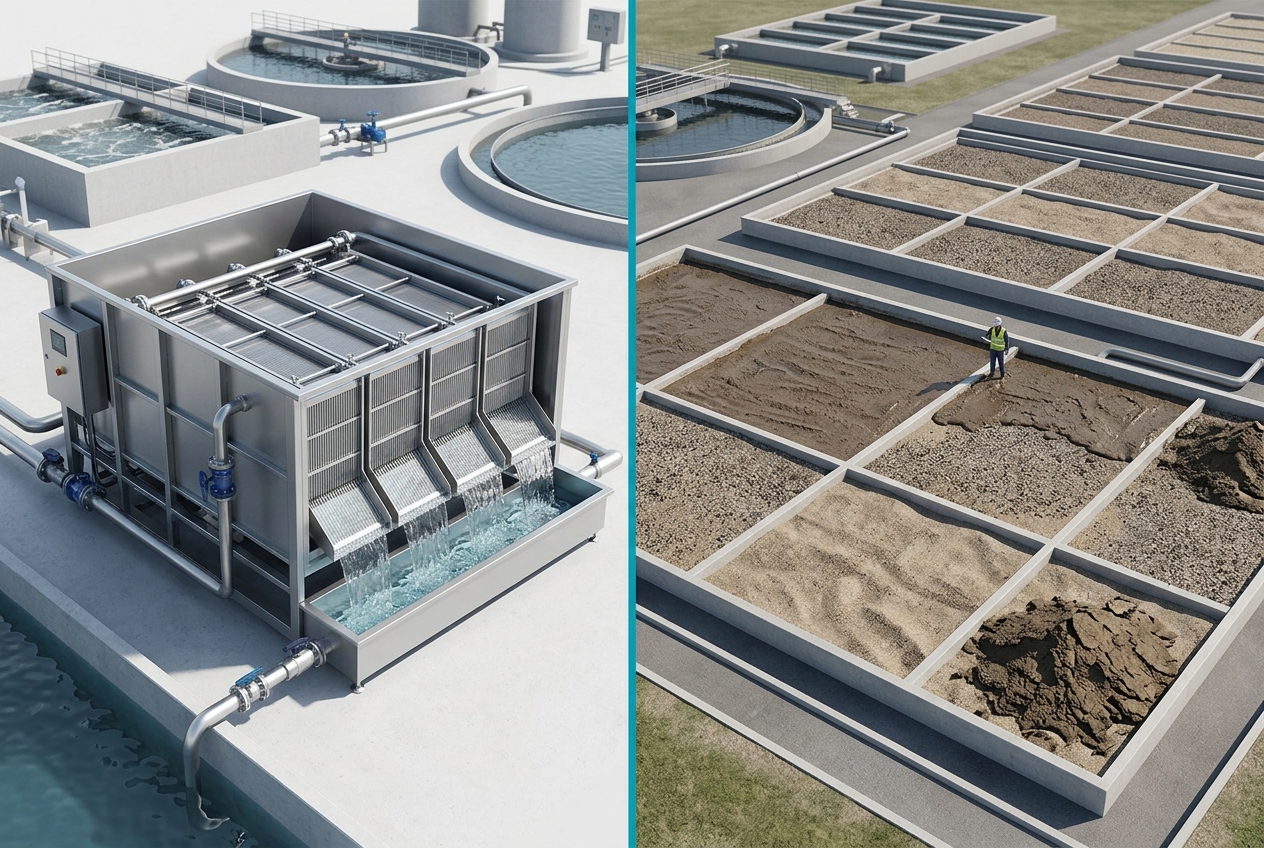
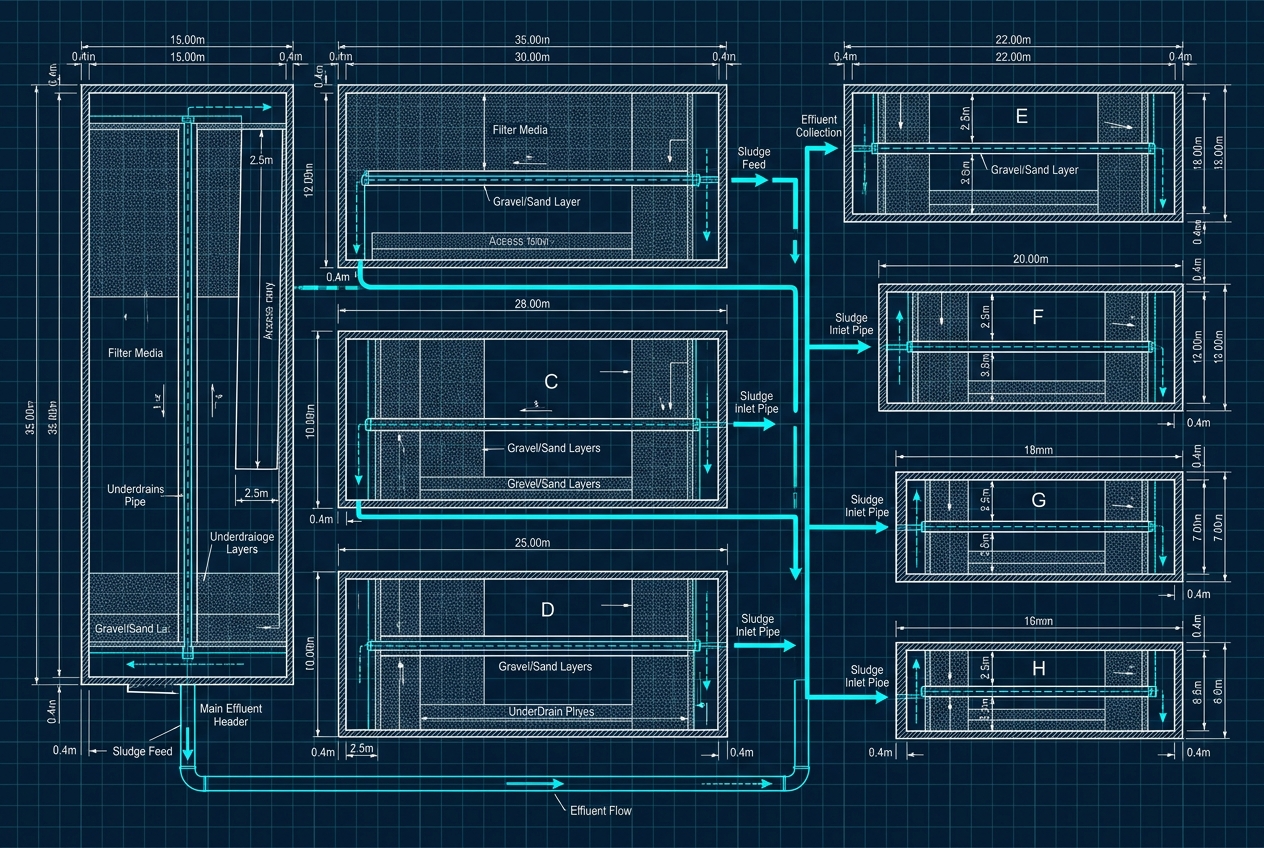
Gravity filter beds dewater sludge through two mechanisms: free drainage and evaporation. Liquid sludge is applied to a bed surface — either traditional sand or modern stainless steel wedgewire — and water drains downward by gravity through the media. Once drainage slows, the exposed cake surface loses additional moisture to evaporation.
The process has no moving parts, requires no electricity for dewatering, and uses no chemical additions beyond whatever conditioning was applied upstream. Typical cycle times for Wedgewater™ stainless steel filter beds run 2–5 days, producing cake at 20–35% dry solids — suitable for direct land application in most states without further processing.
The simplicity is both the strength and the limitation. Gravity is patient, but it isn’t fast.
How Mechanical Dewatering Works
Mechanical systems use applied force — pressure, centrifugal force, or vacuum — to accelerate water removal. Three technologies dominate the municipal market:
Belt Press: Liquid sludge is conditioned with polymer, then sandwiched between two tensioned fabric belts that pass over a series of rollers. Pressure squeezes water through the fabric. Belt presses are continuous-feed systems that run several hours per day, producing cake at 15–25% dry solids. They require ongoing polymer addition, belt washing, and routine roller and belt replacement.
Centrifuge: Sludge is fed into a rotating bowl spinning at 1,500–3,000 RPM. Centrifugal force drives solids to the bowl wall while liquid (centrate) flows inward and out. Centrifuges are fast, have a small footprint, and can achieve 20–30% dry solids. They are also mechanically complex, have high electrical consumption, and require skilled maintenance.
Screw Press: An auger pushes sludge through a tapered, perforated drum under increasing pressure. Screw presses are gentler than centrifuges, run quietly, and consume moderate power. Cake solids typically reach 18–28%. They are a common choice for smaller plants upgrading from sand beds.
Side-by-Side Comparison
| Factor | Gravity (Filter Bed) | Belt Press | Centrifuge | Screw Press |
|---|---|---|---|---|
| Capital cost | Low–Moderate | Moderate | High | Moderate |
| Operating cost | Very low | Moderate–High | High | Moderate |
| Electrical demand | Minimal | Moderate | High | Low–Moderate |
| Polymer requirement | None–Minimal | Required | Required | Often required |
| Staffing requirement | Minimal | Moderate | High (skilled) | Low–Moderate |
| Mechanical complexity | Very low | Moderate | High | Low–Moderate |
| Cake solids | 20–35% | 15–25% | 20–30% | 18–28% |
| Throughput | Batch | Continuous | Continuous | Continuous |
| Footprint | Large | Small–Moderate | Very small | Small |
| Indoor requirement | No | Yes (typically) | Yes | Yes |
The Real Cost Comparison
The sticker price on a belt press or centrifuge often looks competitive with a filter bed installation — but the total cost of ownership tells a different story.
Mechanical system hidden costs:
- Electricity: A typical belt press or centrifuge runs 15–25 kWh per dry ton processed. At commercial rates, this adds up to thousands of dollars annually.
- Staffing: Belt presses and centrifuges require trained operators for daily startup, monitoring, and shutdown. Centrifuges in particular need personnel who understand vibration monitoring, bowl maintenance, and scroll replacement.
- Maintenance: Belts, rollers, seals, and bearings are wearing parts with finite service lives. Centrifuge bowls and scrolls are expensive to replace. Budget 3–7% of capital cost annually for mechanical upkeep.
- Polymer: Continuous polymer feed at $1–3 per pound adds up quickly. A plant processing 500 lbs dry solids per day at 3 lbs polymer per ton would spend over $12,000 per year on polymer alone.
- Downtime: Mechanical equipment breaks. When a belt press goes down for repairs, sludge keeps arriving. Without a backup, the plant is in trouble.
Gravity filter bed costs:
No polymer (or minimal), no electricity for dewatering, no moving parts to maintain or replace. Primary costs are the initial installation, periodic inspection, and the operator hours for sludge application and cake removal. Over a 20-year horizon, the total cost of ownership for a properly sized filter bed system routinely underruns mechanical alternatives by a significant margin.
When Mechanical Makes Sense
Mechanical dewatering is the right choice in specific situations:
- Extreme space constraints — if land area is simply not available for a filter bed footprint, a centrifuge or screw press may be the only option
- Very high throughput — large regional plants processing hundreds of dry tons per day benefit from the continuous-feed efficiency of mechanical systems
- Indoor operations required — in dense urban settings or facilities without outdoor space, indoor mechanical equipment is the only viable path
When Gravity Wins
For most small to mid-sized municipal plants, gravity filter beds are the better long-term investment:
- Small and mid-sized plants — facilities in the 0.1–5 MGD range typically generate sludge volumes that match well with filter bed capacity
- Budget-conscious operations — lower operating costs mean more predictable budget year-over-year
- Understaffed facilities — rural and small-town plants often can’t support the staffing demands of continuous mechanical operation
- Replacing sand beds — plants with existing sand bed infrastructure are natural candidates for Wedgewater™ upgrades that use the same footprint with much faster cycle times
- Long-term reliability focus — no moving parts means no mechanical failure modes and no unplanned downtime
Ready to compare options for your plant? Request a quote and our engineering team will walk through your sludge volumes, site constraints, and budget to recommend the right fit.
Related: Common Dewatering Problems | Wedgewater™ Filter Bed product page